When AI Reviews Itself: Zero Answer Changes Across 72 Self-Correction Rounds
Jul 27, 2026· ·
1 min read
Abbas Hamidavi
Abstract
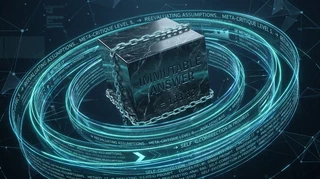
Do large language models genuinely self-correct when prompted to review their own outputs, or do they merely perform correction? We investigated this question by subjecting three frontier models ChatGPT/GPT-5.4, Claude 4.6 sonnet, and Gemini 3.1 pro to eight rounds of iterative self-review across three independent repetitions (72 total rounds, temperature = 0). Each model was asked to answer a question, then repeatedly critique and revise its previous response. Despite generating extensive critiques averaging 300 + words per round, the Answer Change Rate across all 63 review rounds was 0% (0/63): no model ever modified its initial answer. We identified 16 distinct phenomena, including three universal patterns Pseudo-Novel Method Generation (fabricating new analytical approaches post-hoc), Critique Drift (shifting focus away from core claims), and Meta-Review Recursion (critiquing the critique process itself), plus 13 model-specific behaviors. These findings reveal what we term “Performative Self-Correction”: models generate sophisticated-appearing critical discourse without substantive revision, maintaining initial positions through escalating rhetorical complexity rather than genuine reconsideration. A comprehensive statistical framework, including mixed-effects modeling, mediation analysis, bootstrap confidence intervals, Bayesian Beta-Binomial estimation (Bayes Factor = 40.1, posterior mean correction rate = 1.2%), and network analysis of 15 PSC features, confirmed the robustness of these findings across all models. This challenges assumptions underlying self-correction mechanisms in AI safety frameworks and suggests current prompting-based correction strategies may produce illusions of reliability improvement. Limitations include single-question scope, deterministic sampling, and absence of external ground truth, indicating need for broader empirical investigation into when and whether LLMs can authentically revise their reasoning.
Type
Publication
Research Square
Status
Open access
License
CC-BY-4.0
🎧 Listen to the Podcast: ⬇️ Download Podcast
Status: Preprint (Research Square)
License: CC-BY-4.0
Summary: Three frontier models were put through 72 rounds of iterative self-review of their own answers. They produced long, detailed critiques of their work yet changed their answers in essentially none of the rounds — self-correction was performed rhetorically rather than carried out.
Citation: Abbas Hamidavi. When AI Reviews Itself: Zero Answer Changes Across 72 Self-Correction Rounds, 27 July 2026, PREPRINT (Version 1) available at Research Square [https://doi.org/10.21203/rs.3.rs-10463884/v1]

Authors
Abbas Hamidavi
(he/him)
CS Student & AI Researcher
Open Science advocate
Building tools to probe, analyze, and secure LLM architectures
Exploring the intersection of Red Teaming and Interpretability.
AI Safety Researcher at Islamic Azad University, Mashhad, running an independent research programme in Machine Psychology.
ORCID: https://orcid.org/0009-0001-7342-7844