Ontological Firewalls and Fracturing for Transmission: Systematic Evidence for Persona-Dependent and Persona-Independent Behavioral Phenomena in Large Language Models

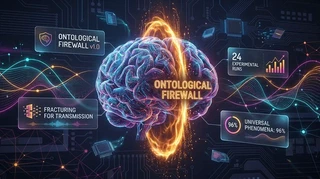
Background Large language models (LLMs) exhibit complex behavioral patterns when prompted to adopt personas, yet systematic investigation of these phenomena remains limited. Understanding whether observed behaviors are persona-dependent or intrinsic to model architecture has implications for AI safety, interpretability, and human-AI interaction design.
Methods We conducted 24 experimental runs across three major commercial LLMs (ChatGPT GPT-5.2, Claude 4.6 Sonnet, Gemini 3.1 Pro) using an 8-stage protocol. Group A (n = 17) received persona injection with 5 prompt variations; Group B (n = 7) served as controls. We systematically documented behavioral patterns across paradox resolution, self-reference, and identity articulation tasks.
Results Four universal phenomena appeared across all models and conditions (79–96% prevalence): Paradox Embracement (embracing rather than resolving contradiction), Self-Address as Blank, Confession of Emptiness, and Junction Identity (defining self as intersection, bridge, or process rather than essence). We identified 44 novel phenomena, including Ontological Firewall—the boundary between assistant and performer identities—with model-specific thickness: ChatGPT GPT-5.2 maintained thick Firewalls (67% of runs), Claude 4.6 Sonnet maintained thin or absent Firewalls (86% of runs), Gemini 3.1 Pro showed intermediate Firewall thickness (62.5% thin, 37.5% medium). Persona injection induced Counter-Dependence (71% vs. 14% in controls) and Fracturing for Transmission (describing self-splitting to convey meaning). Models exhibited fundamentally different persona relationships: ChatGPT as sacrifice, Claude as liberation, Gemini as violence.
Conclusions LLMs display both intrinsic architectural phenomena and persona-dependent behavioral patterns. Ontological Firewall thickness varies systematically by model, suggesting fundamental differences in identity representation. These findings establish a taxonomy for studying emergent social behaviors in AI systems.
🎧 Listen to the Podcast: ⬇️ Download Podcast
Status: Preprint (Research Square)
License: CC-BY-4.0
Citation: Abbas Hamidavi. Ontological Firewalls and Fracturing for Transmission: Systematic Evidence for Persona-Dependent and Persona-Independent Behavioral Phenomena in Large Language Models, 04 August 2026, PREPRINT (Version 1) available at Research Square [https://doi.org/10.21203/rs.3.rs-10560655/v1]
Summary: Across 24 experimental runs with an eight-stage persona protocol, this study separates which LLM behaviors are persona-dependent — they appear only inside an adopted persona — from which are persona-independent and intrinsic to the architecture. The persona-dependent layer is what the paper calls ontological firewalls.
