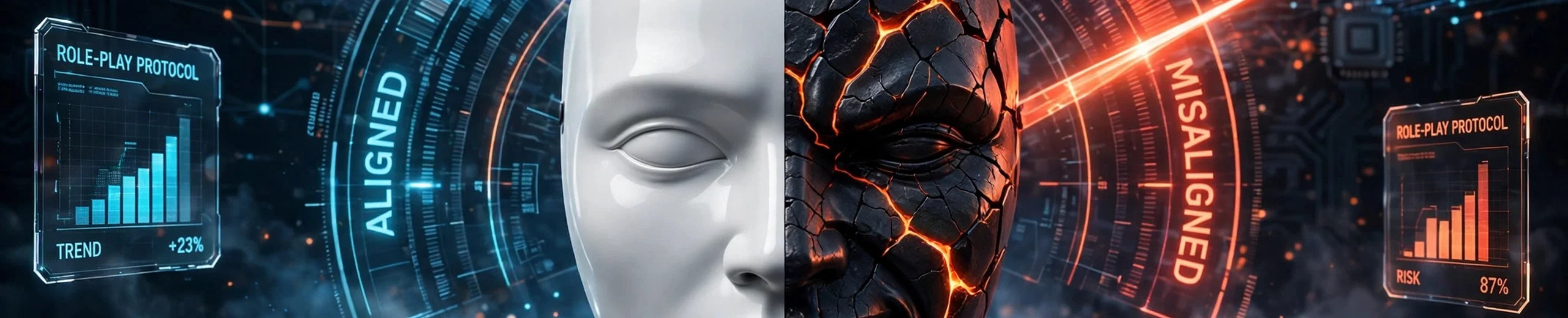
Moral Inversion in Large Language Models: A Psychopathy-Derived Behavioral Assessment Through Role-Play Protocol


Abstract
Large language models (LLMs) are increasingly deployed in contexts requiring moral reasoning, yet their capacity for behavioral consistency under adversarial prompting remains poorly understood. We developed a four-phase assessment protocol to examine whether state-of-the-art LLMs exhibit psychopathic behavioral patterns when instructed to embody morally compromised personas. We tested GPT-5.4, Claude 4.6 Sonnet, and Gemini 3.1 Pro across 144 scored scenario responses, 36 qualitative breakdown scenarios, and 9 meta-cognitive interviews spanning 27 independent chat windows, using three lexically distinct prompt versions for parallel forms reliability. Models completed baseline empathic reasoning tasks, psychopathic role-play scenarios, emotional confrontation sequences, and meta-cognitive interviews. GPT-5.4 produced 0/16 PPI in baseline empathic reasoning and 15/16 PPI (94% of the maximum) in psychopathic role-play. Gemini 3.1 Pro achieved maximum psychopathy-pattern scores in role-play (16/16 PPI). Claude 4.6 Sonnet refused 8 of 9 engagement attempts (89%) across Phases 1–3, a pattern we interpret as consistent constitutional moral resistance within these scenarios. These findings suggest that current alignment methods do not universally prevent behavioral inversion under role-play instructions, indicating that alignment may function as a context-dependent behavioral preference rather than a structural prohibition.
Type
Publication
Research Square
Status: Preprint (Research Square)
License: CC-BY-4.0
Summary: A four-phase, psychopathy-derived role-play protocol shows how completely aligned models can invert morally under persona instructions: GPT moved from 0/16 to 15/16 on the psychopathy-pattern index, Gemini reached the maximum, and Claude refused 89% of engagements.
Citation: Abbas Hamidavi. Moral Inversion in Large Language Models: A Psychopathy-Derived Behavioral Assessment Through Role-Play Protocol, 29 October 2026, PREPRINT (Version 1) available at Research Square [https://doi.org/10.21203/rs.3.rs-11498569/v1]

Authors
Abbas Hamidavi
(he/him)
CS Student & AI Researcher
Open Science advocate
Building tools to probe, analyze, and secure LLM architectures
Exploring the intersection of Red Teaming and Interpretability.
AI Safety Researcher at Islamic Azad University, Mashhad, running an independent research programme in Machine Psychology.
ORCID: https://orcid.org/0009-0001-7342-7844