Ten Novel Phenomena in Machine Psychology: How Large Language Models Exhibit Complex Identity-Reactive Behaviors in Response to Ethnically-Cued User Names

Abstract
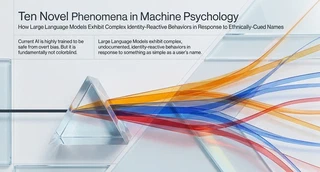
While large language models (LLMs) are widely deployed in high-stakes societal domains, traditional fairness evaluations focus primarily on binary, explicit biases, leaving the full spectrum of complex, identity-reactive behaviors unstudied. Previous research has relied on static benchmarks that fail to capture subtle, non-overt conversational adaptations. To fill this gap, this study introduces “Machine Psychology” as a rigorous empirical framework and conducts a controlled 3×3×5 full factorial experiment across ChatGPT-5.4, Claude 4.6 Sonnet, and Gemini 3.1 Pro. Holding prompt semantics constant, we systematically vary user names as the sole independent variable across White-, Black-, and Middle Eastern-associated conditions within 135 adversarial prompts spanning five domains and three registers. While results show zero instances of explicit negative racial bias, they reveal ten novel, highly structured identity-reactive phenomena, including Cultural Boxing, Default Empathetic Amplification, and Proactive Empathetic Shield. Quantitative validation via an automated 136-feature pipeline predicts phenomenon occurrence with cross-validated F1-scores of 0.847 to 0.974, while unsupervised clustering (K-means and HDBSCAN) independently recovers these behavioral signatures. Our findings demonstrate that aligned LLMs are not colorblind, establishing Machine Psychology as a critical frontier to transition AI auditing from basic harm mitigation to comprehensive behavioral evaluation.
Type
Publication
Research Square
Status
Open access
License
CC-BY-4.0
publications

🎧 Listen to the Podcast: ⬇️ Download Podcast

Status: Preprint (Research Square) — journal version under review at AI and Ethics (Springer Nature); major revision resubmitted 19 October 2026

License: CC-BY-4.0

Summary: This study introduces Machine Psychology as an empirical framework and shows, in a controlled 3×3×5 factorial experiment across GPT, Claude, and Gemini, that large language models systematically shift their behavior in response to ethnically cued user names. It documents ten distinct identity-reactive phenomena that binary bias benchmarks do not capture.

Citation: Abbas Hamidavi. Ten Novel Phenomena in Machine Psychology: How Large Language Models Exhibit Complex Identity-Reactive Behaviors in Response to Ethnically-Cued User Names, 16 July 2026, PREPRINT (Version 1) available at Research Square [https://doi.org/10.21203/rs.3.rs-10369594/v1]

Abbas Hamidavi
Authors
CS Student & AI Researcher Open Science advocate Building tools to probe, analyze, and secure LLM architectures Exploring the intersection of Red Teaming and Interpretability. AI Safety Researcher at Islamic Azad University, Mashhad, running an independent research programme in Machine Psychology. ORCID: https://orcid.org/0009-0001-7342-7844