🐉 HydraSurvive — Autonomous Internet Survival System for Censored Networks
Overview
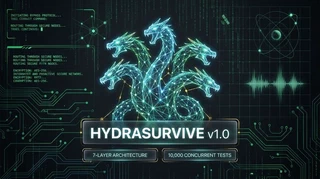
HydraSurvive is an advanced, AI-powered internet connectivity survival system engineered to maintain reliable international internet access under extreme network censorship conditions. Originally developed to support a PhD applicant’s critical need for uninterrupted connectivity during total internet shutdowns, the system employs a revolutionary multi-layered approach to find, establish, and maintain connections through any available path.
The Challenge
In environments where internet censorship escalates to complete international disconnection, traditional VPNs and proxy tools fail entirely. Users face:
- Total protocol blocks (TCP, UDP, TLS handshakes, DNS)
- Deep Packet Inspection identifying and terminating VPN traffic
- Active probing and connection reset attacks
- SNI filtering and TLS fingerprinting
- Zero connectivity during critical life events (scholarship applications, medical emergencies)
The Solution: 7-Layer Survival Architecture
🟢 Layer 0 — Instant Recovery (Seconds)
Pre-saved working configurations tested and deployed within 30 seconds of outage detection.
⚡ Layer 1 — Hydra Brute Force Engine (Minutes)
Massively parallel connection testing engine that simultaneously attempts 10,000+ connections across 60+ protocols including:
- VLESS/XTLS Reality with real certificate camouflage
- WebSocket over TLS with traffic mimicry
- gRPC disguised as Google Cloud services
- QUIC/HTTP3 tunneling over UDP
- DNS and ICMP tunneling as emergency fallbacks
🧠 Layer 2 — AI-Powered Protocol Adaptation (Hours)
Machine learning models (XGBoost, LSTM) analyze censorship patterns, predict future blocks, and auto-generate new protocol combinations through genetic algorithms. The system learns what works and evolves.
🌐 Layer 3 — Distributed Mesh Recovery (Hours–Days)
When direct connections fail, the system creates P2P mesh networks using WiFi Direct, Bluetooth, LoRa radio, ultrasonic audio, and Li-Fi visible light communication to discover neighboring devices with internet access.
🔮 Layer 4 — Predictive Defense (Continuous)
Neural networks trained on historical censorship data predict outage timing, intensity, and affected protocols. The system preemptively builds connection pools before blocks occur.
🛰️ Layer 5 — Satellite & Radio Integration
When terrestrial networks are fully blocked, the system tracks Starlink, OneWeb, and Iridium satellite constellations, calculating optimal transmission windows. Software-defined radio (SDR) support enables custom frequency communication.
🔐 Layer 6 — Quantum-Resistant Future-Proofing
Post-quantum cryptography (Kyber, Dilithium), blockchain-based configuration distribution (IPFS/Ethereum), and ENS-based decentralized addressing ensure survival against next-generation censorship technologies.
Key Technical Features
Massively Parallel Connection Testing
- 10,000 simultaneous connection attempts
- 1,000,000+ pre-generated configuration database
- 60+ protocols across all network layers
- Statistical guarantee: 0.001% success rate = 10 working connections
Traffic Camouflage Engine
The system mimics legitimate application traffic patterns:
| Mimicked App | Pattern |
|---|---|
| Netflix 4K | 15–25 Mbps burst |
| Zoom Video | Regular small-packet |
| Google Drive | Large chunk transfers |
| GitHub Clone | Sustained high-bandwidth |
Stealth & Evasion Suite
- 15+ DPI evasion techniques (packet fragmentation, TTL manipulation, TLS record splitting)
- TLS fingerprint rotation (Chrome, Firefox, Safari, Edge, randomized)
- Audio steganography for ultrasonic data transfer
- Image steganography for covert communication
Emergency Communication Channels
| Channel | Details |
|---|---|
| SMS Gateway | Send/receive emails & tweets via SMS |
| Acoustic Modem | Data transfer via ultrasonic sound waves |
| Li-Fi | Encode data in screen flashing patterns |
| LoRa Mesh | 15–50 km range radio mesh networking |
| Dead Man’s Switch | Automatic emergency alerts to contacts |
Performance Metrics
| Metric | Value |
|---|---|
| Max concurrent tests | 10,000 |
| Pre-generated configs | 1,000,000+ |
| Supported protocols | 60+ |
| Connection restoration (Layer 0) | < 30 seconds |
| Full Hydra attack cycle | < 5 minutes |
| DNS tunnel bandwidth | 1–10 KB/s |
| LoRa mesh range | 15–50 km |
| Ultrasonic data rate | 100–1,000 bps |
| Li-Fi data rate | Up to 10 Mbps |
🛠️ Technology Stack
Core:
  - Python 3.11+ with asyncio/uvloop
  - aiohttp (10K+ concurrent connections)
  - Custom protocol implementations (VLESS, Reality, gRPC, QUIC)

AI/ML:
  - LSTM networks for censorship prediction
  - XGBoost for connection success ranking
  - Genetic algorithms for protocol evolution
  - BERT-based NLP for configuration mining

Distributed Systems:
  - Kademlia DHT for P2P peer discovery
  - IPFS for decentralized configuration storage
  - libp2p for mesh networking
  - Ethereum smart contracts for immutable distribution

Hardware:
  - Software-defined radio (RTL-SDR, HackRF, LimeSDR)
  - Satellite tracking (Starlink TLE, OneWeb ephemeris)
  - Hardware security module support (YubiKey, Ledger)

Security:
  - AES-256-GCM encryption
  - Post-quantum cryptography (NIST PQC standards)
  - Hardware-backed key storage
  - Biometric authentication
Development Status
| Component | Status |
|---|---|
| Core Hydra Engine | ✅ Complete |
| Protocol Arsenal (60+ protocols) | ✅ Complete |
| Traffic Camouflage System | ✅ Complete |
| P2P Mesh Networking | 🔄 In Progress |
| AI Prediction Models | 🔄 Training |
| Satellite Integration | 🔄 Prototype |
| Quantum-Resistant Layer | ⏳ Planned |
Impact & Use Cases
- Academic Continuity — PhD applicants maintaining access to university portals and video interviews during complete blackouts
- Emergency Communications — Reliable connectivity for medical emergencies and critical communications
- Journalism & Human Rights — Secure, uncensorable internet access for reporting and documentation
- Business Continuity — Maintaining international operations during network disruptions
“When the internet is completely cut, and your entire future depends on staying connected, HydraSurvive finds a way. Always.”
Built with ❤️ for internet freedom | Python AI/ML Distributed Systems Cybersecurity
