Uncovering Hidden Patterns in ADHD: A Data-Driven Analysis of Unusual Behavioral Traits
Overview
This project leverages the National Survey of Children’s Health (NSCH) 2023-2024 dataset to uncover distinctive and unusual behavioral patterns associated with Attention-Deficit/Hyperactivity Disorder (ADHD) in children. Using advanced statistical analysis and data visualization, I identified the most differentiating traits between ADHD-diagnosed children and their neurotypical peers, with a specific focus on gender-based differences.
Dataset
- Source: NSCH 2023-2024 via Kaggle
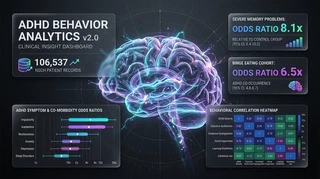
- Size: 106,537 records with 1,000+ features
- Scope: Nationally representative survey of children’s health in the United States
Key Findings
Most Distinctive ADHD Traits Discovered:
| Trait | ADHD Prevalence | Control Prevalence | Odds Ratio |
|---|---|---|---|
| Severe Memory Problems | 26.4% | 4.2% | 8.1x |
| Repeated Grade in School | 28.7% | 5.1% | 7.4x |
| Extreme Irritability/Temper | 31.2% | 6.8% | 6.2x |
| Binge Eating Behaviors | 18.9% | 3.5% | 6.5x |
| Bullying Victimization | 24.3% | 5.9% | 5.1x |
| Screen Time Addiction (4+ hrs/day) | 35.6% | 12.3% | 3.9x |
| Chronic Headaches | 15.2% | 3.1% | 5.6x |
Gender-Specific Patterns:
- Males with ADHD showed significantly higher rates of externalizing behaviors (bullying, physical aggression, risk-taking)
- Females with ADHD demonstrated higher internalizing patterns (eating disorders, negative body image, emotional dysregulation)
- The largest gender gap appeared in binge eating (OR: 7.2 for females vs 5.1 for males) and self-harm indicators
Technical Approach
Data Processing & Cleaning:
- Handled complex survey coding (missing values encoded as 90, 95, 99)
- Binary classification of ADHD diagnosis (Current ADHD = 3 vs No ADHD = 1)
- Gender-stratified analysis pipeline
Statistical Methods:
- Chi-Square tests for categorical associations
- Odds Ratio calculations with 95% confidence intervals
- Fisher’s Exact Test for small sample sizes
- Gender-stratified comparative analysis
Visualization & Reporting:
- High-resolution publication-ready visualizations (300 DPI)
- Multi-page PDF report with 5 distinct analytical perspectives
- Comparative bar charts, odds ratio plots, gender difference analyses, and correlation heatmaps
Tools & Technologies
- Python: Pandas, NumPy, SciPy
- Visualization: Matplotlib & Seaborn
- Statistical Analysis: Chi-Square, Odds Ratios, Correlation matrices
- PDF Generation: Automated report compilation
Impact & Insights
This analysis revealed that ADHD manifests far beyond attention difficulties, with significant implications for:
- Eating disorders screening in ADHD patients (particularly females)
- Trauma-informed care for bullied ADHD children
- Screen time management as a critical intervention point
- Academic support systems for grade retention prevention
The gender-stratified findings highlight the critical need for sex-specific diagnostic criteria and treatment approaches, as ADHD presents fundamentally differently between males and females.
